
Kidney stone treatment removes or breaks up stones that are too large to pass, keep causing pain, block urine flow or cause infection, using shock waves (ESWL), a ureteroscope (URSL, RIRS) or keyhole surgery through the back (PCNL). Most people go home within three days and return to desk work within two weeks. The choice depends on the stone’s size, position and hardness and on your kidney anatomy, not on a single preferred technique.
YOUR SURGEON
Who treats this at Lotus
Urology
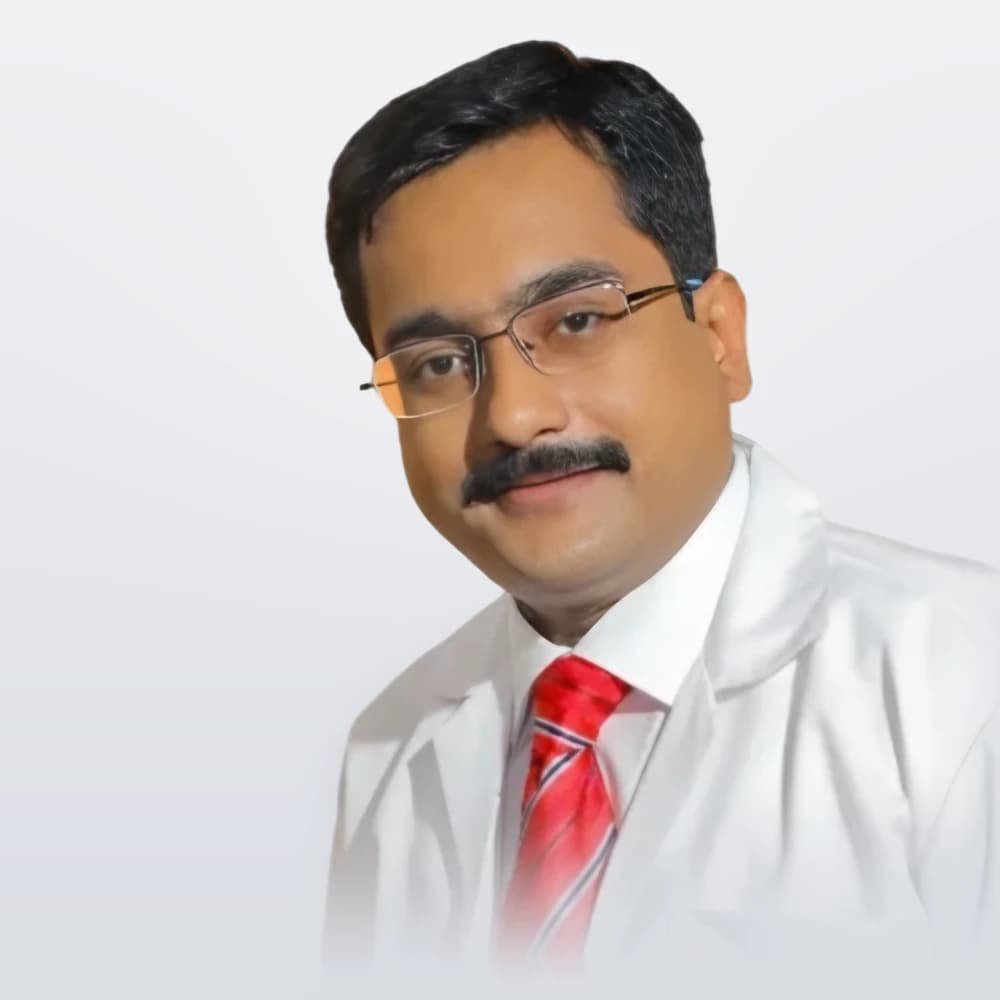
Dr. Manohar Badrappa
Also listed as Dr. Manohar
- Qualifications
- MBBS, MS (General Surgery), MCh (Urology)
- Experience
- 24 years
- Fee
- ₹700
- Languages
- English, Hindi, Kannada, Tamil, Telugu
- Registration
- KMC 63476
Kidney and ureteric stones · Urinary difficulty · Blood in urine · Prostate symptoms
Urology
Dr. Bivek Kumar
- Qualifications
- MBBS, MS (General Surgery), MCh (Urology)
- Experience
- 17 years overall; 9 as specialist
- Fee
- ₹700
- Languages
- English, Hindi, Kannada, Malayalam, Bengali
- Registration
- KMC 85041
★ 90% (101 votes) on Practo
Kidney stones · Prostate · Male reproductive health
COST IN BANGALORE
How much does kidney stone treatment cost in Bangalore?
₹50,000 to ₹1,80,000Bengaluru market range · HexaHealth — RIRS surgery cost in Bangalore ↗ · as of 2026-10-14
Typical hospital stay: 1 to 2 days
Bengaluru market estimate for retrograde intrarenal surgery (RIRS) for kidney stones, as published by HexaHealth (average ₹90,000). PCNL, URSL and lithotripsy are priced differently and depend on stone size and position. This is not a Lotus quote. Ask the Lotus team for an itemised estimate for your case and insurance.
What is included, excluded and what changes the price →INSURANCE & CASHLESS
Using health insurance at Lotus
Lotus works with health insurers and TPAs for cashless and reimbursement claims. Share your policy details before a planned admission and the care team checks eligibility and pre-authorisation for you.
Do all kidney stones need surgery?
No. Many stones smaller than about 5 mm pass on their own within a few weeks, and some stones in the ureter up to about 10 mm can be helped to pass with medicine that relaxes the ureter. Small stones in the kidney that cause no pain, infection or blockage are often monitored with periodic scans. Pain from a passing stone can be severe, but severe pain alone does not always mean surgery is needed.
Treatment is advised when a stone is unlikely to pass because of its size, when pain cannot be controlled, when the stone has not moved after a reasonable trial, when kidney function is affected, or when the person has a single kidney, a stone in both ureters, or a job where sudden colic is unsafe. A blocked kidney with fever is an emergency: the first step is usually to drain the kidney with a stent or a tube through the back, and the stone is treated later once the infection settles.
- Stones unlikely to pass because of size
- Pain not controlled with medicines
- No progress after a trial of passage
- Blockage affecting kidney function
- Fever with a blocked kidney (emergency drainage first)
- Single kidney or stones on both sides
Can kidney stones be treated without surgery, and how do I prevent new ones?
Non-surgical care includes pain relief (anti-inflammatory medicines are usually first choice if kidney function allows), medicines that help ureteric stones pass, and drinking enough fluid. Uric acid stones can sometimes be dissolved with medicines that make the urine less acidic. Your urologist will give a time limit for waiting, typically a few weeks, with a repeat scan.
About half of people who have had a stone form another within several years, so prevention matters. Aim to drink enough fluid through the day to pass about two and a half litres of pale urine, more on hot days or after outdoor work. Reduce salt, including pickles, papad and packaged snacks; keep animal protein moderate; and do not cut out dietary calcium such as milk and curd, because low calcium intake can increase oxalate absorption. Very high-oxalate foods such as spinach can be eaten in moderation rather than banned. Lemon water adds citrate, which may help some people. Recurrent stone formers should have a stone analysis and blood and urine tests.
- Pain relief and medicines to help passage
- Dissolution therapy for uric acid stones
- Enough fluid for about 2.5 litres of urine a day
- Lower salt and moderate animal protein
- Normal dietary calcium
- Stone analysis and metabolic tests if recurrent
How is the treatment decided, and what tests are needed?
A low-dose non-contrast CT scan of the kidneys, ureters and bladder (CT KUB) is the most accurate way to show the size, number, position and density of stones; ultrasound is used for pregnancy, children and follow-up. Blood tests check kidney function, calcium and infection markers, and a urine test and urine culture look for infection, which must be treated before planned surgery. Women of childbearing age have a pregnancy test before X-ray based procedures.
The urologist then weighs stone size and location, stone hardness on CT, the angle of the lower part of the kidney, previous treatments, body size, blood-thinning medicines and your preferences about stents, anaesthesia and the number of sessions. More than one approach may be reasonable, and a frank discussion of the trade-offs, such as a smaller first procedure with a chance of a second one, helps you decide.
- Which technique do you recommend for my stone, and why?
- What is the chance I will need a second procedure?
- Will I have a stent, and when will it come out?
- Can I wait, and for how long is waiting safe?
- Should I stop any blood thinners?
- What tests will tell us why I form stones?
PCNL vs RIRS vs URSL vs ESWL: how are kidney stones removed?
ESWL (extracorporeal shock wave lithotripsy) focuses shock waves on the stone from outside the body; the fragments pass in the urine over the following weeks. It needs no cut, but works less well for hard stones, larger stones and stones in the lower part of the kidney, and may need repeat sessions. URSL (ureteroscopy with lithotripsy) passes a thin telescope through the urethra and bladder into the ureter, where a laser breaks the stone and fragments are removed or dusted. RIRS (retrograde intrarenal surgery) uses a flexible ureteroscope that bends into the kidney to treat stones there.
PCNL (percutaneous nephrolithotomy) makes a small tunnel through the back directly into the kidney to break and remove larger stones, typically those over about 2 cm or complex staghorn stones. Smaller-tract versions (mini-PCNL) are used for medium-sized stones. A review comparing PCNL with RIRS found PCNL gives higher stone-free rates for larger stones, at the cost of more complications and a longer stay. A temporary double-J stent may be left after URSL, RIRS or PCNL to keep urine draining; it must be removed, usually within days to a few weeks.
- ESWL: no cut, suited to smaller, softer stones
- URSL: telescope and laser for ureteric stones
- RIRS: flexible scope for kidney stones up to about 2 cm
- Mini-PCNL: small tunnel for medium-to-large stones
- PCNL: keyhole tunnel for large or staghorn stones
- Temporary stent in many cases, removed later
How long is the hospital stay after kidney stone surgery?
ESWL is usually done with pain relief or light sedation and you go home the same day. URSL and RIRS are performed under general or spinal anaesthesia and are often day-care or overnight procedures. PCNL is performed under general anaesthesia and usually needs one to three nights; a small drainage tube from the kidney (nephrostomy) may be left for a day or two, though many patients now go home without one.
After any procedure you may see blood-tinged urine for a few days and feel discomfort in the side or bladder. Drink plenty of fluids unless told otherwise. If you live farther out in Bengaluru, plan to rest at home rather than travel the next day, and keep the discharge summary handy in case you need care elsewhere.
- ESWL: same-day discharge
- URSL or RIRS: same day or one night
- PCNL: usually one to three nights
- Stent or nephrostomy plan explained before discharge
- Blood-tinged urine for a few days
- Follow-up scan to check stone clearance
What are the risks of kidney stone surgery?
All stone procedures carry a risk of urinary infection and, occasionally, a serious blood infection (sepsis), which is why urine is cultured beforehand and antibiotics are given. Fragments may remain and need another treatment. After ESWL, fragments can line up in the ureter and block it (steinstrasse), and bruising of the kidney can occur. Ureteroscopy can rarely injure the ureter, which may later narrow (stricture).
PCNL carries a higher risk of bleeding, sometimes needing transfusion or, rarely, a procedure to seal a bleeding vessel, and a small risk of injury to nearby organs or the lining of the lung. Stents often cause bladder irritation, frequent urination, a need to rush, side pain when passing urine and blood in the urine; these settle after removal. Never leave a stent in beyond the planned date, because forgotten stents can become encrusted and block the kidney.
- Urinary infection and sepsis
- Residual fragments needing further treatment
- Steinstrasse after ESWL
- Ureteric injury or stricture (uncommon)
- Bleeding after PCNL
- Stent discomfort; stent must be removed on time
Recovery after kidney stone surgery, week by week
Recovery is usually quick after ESWL and ureteroscopy, and a little slower after PCNL. Most discomfort in the first week comes from the stent, if one is placed. Painkillers and medicines that relax the bladder can help; the team will tell you which ones to take. Avoid heavy lifting and strenuous exercise until the stent is out and, after PCNL, for about two to four weeks.
Short drives are possible when you are off strong painkillers and comfortable, but many people prefer not to drive with a stent in place because of the urge to pass urine during long Bengaluru commutes. Keep drinking well, and add the prevention advice from your stone analysis once results are available.
- Days 1 to 3: home; blood-tinged urine; side or bladder discomfort; plenty of fluids
- Week 1: return to desk work for many after ESWL or ureteroscopy; stent symptoms common
- Weeks 1 to 3: stent removal, often a short procedure in the clinic or theatre
- Week 2: PCNL patients back to light work; wound site healing
- Weeks 4 to 6: repeat scan to confirm clearance; stone analysis discussed
- Months 3 onwards: prevention plan and periodic follow-up
How much does kidney stone treatment cost in Bangalore?
Costs differ mainly by technique and complexity. ESWL may be priced per session, and a hard or large stone may need several sessions. Ureteroscopy and RIRS involve scopes, laser fibres, guide wires, access sheaths, baskets and stents, which are significant consumables. PCNL involves theatre time, more consumables and a longer stay. Treating stones on both sides, staged procedures, or an emergency drainage before definitive treatment add to the total.
Room category, days in hospital, pre-operative CT, blood tests, urine culture, stone analysis, stent removal and follow-up scans also matter, as do medical conditions such as diabetes or kidney disease. Ask Lotus for an itemised estimate that lists consumables, stent removal and follow-up, and what happens to the cost if a second procedure is needed.
- Technique: ESWL, URSL, RIRS or PCNL
- Number of sessions or staged procedures
- Laser fibres, scopes, sheaths, baskets and stents
- Room category and length of stay
- Pre- and post-operative scans and tests
- Stent removal and follow-up inclusions
Does insurance cover kidney stone surgery, and how does cashless work?
Kidney stone procedures are usually covered by Indian health insurance, including day-care procedures such as ESWL or ureteroscopy under many policies. However, many retail policies list urinary stones among conditions with a specific waiting period, often one to two years and sometimes longer, and stones diagnosed before the policy are treated as pre-existing. Emergency admission for an obstructed, infected kidney is handled as an emergency, with intimation to the insurer within the time stated in the policy.
For planned treatment, the hospital submits a pre-authorisation request to the insurer or TPA with your CT report, urologist’s notes and estimate, ideally a few days before admission. Bring your policy card and photo ID. Check whether ESWL sessions are covered individually, whether stent removal is covered as a separate admission, and whether there are room-rent caps or co-payment. Some consumables are non-payable under insurance rules.
- Specific waiting period for urinary stones
- Day-care coverage for ESWL and ureteroscopy
- Pre-authorisation with CT report and notes
- Coverage for each ESWL session and stent removal
- Room-rent caps and co-payment
- Non-payable consumables
Warning signs after kidney stone treatment
Some blood in the urine and mild side pain are expected, particularly with a stent. Contact the Lotus team or go to the nearest emergency department urgently if you notice any of the following, because infection with a blocked kidney can become dangerous quickly.
- Fever of 38°C or more, shivering or chills
- Severe side pain not controlled with prescribed medicines
- Unable to pass urine, or very little urine
- Heavy bleeding or thick clots in the urine
- Vomiting and unable to keep fluids down
- Leakage, bleeding or redness at a nephrostomy or PCNL site
- Breathlessness or chest pain after PCNL
- Stent still in place beyond the planned removal date
- NICE NG118 — Renal and ureteric stones: assessment and management ↗
- EAU Guidelines on Urolithiasis ↗
- AUA Guideline — Surgical management of kidney and ureteral stones ↗
- NHS — Kidney stones ↗
- PCNL versus RIRS: systematic review and meta-analysis — Eur Urol, 2015 (PubMed) ↗
Medical information is general and does not replace an individual consultation.
PATIENT QUESTIONS
Kidney Stone Treatment: questions patients ask
How much does kidney stone surgery cost in Bangalore?
It depends on the technique (ESWL, URSL, RIRS or PCNL), stone size and number, whether more than one session or a staged procedure is needed, consumables such as laser fibres, sheaths and stents, room category and length of stay. Stent removal and follow-up scans also count. Ask Lotus for an itemised estimate for your scan findings.
Which is better for kidney stones: RIRS, PCNL or ESWL?
None is better for everyone. ESWL suits smaller, softer stones; RIRS suits many kidney stones up to about 2 cm and avoids a cut; PCNL clears large or complex stones more reliably but with a longer stay and higher bleeding risk. Your urologist chooses based on size, location, hardness, kidney anatomy and your health.
What size of kidney stone needs surgery?
Stones under about 5 mm usually pass on their own, and ureteric stones up to about 10 mm may pass with medicine. Larger stones, stones that have not moved after a few weeks, or any stone causing uncontrolled pain, infection or blockage usually need treatment. Size is only one factor; position and symptoms matter too.
How long is the hospital stay after kidney stone surgery?
ESWL is a same-day procedure. URSL and RIRS are often day-care or need one night. PCNL usually needs one to three nights, sometimes with a temporary drainage tube from the kidney. Infection, bleeding or other medical conditions can lengthen the stay. The care team confirms the expected stay before admission.
Will I need a stent after stone removal, and is it painful?
Many people have a temporary double-J stent after ureteroscopy, RIRS or PCNL to help urine drain while swelling settles. Stents commonly cause frequent urination, urgency, side discomfort when passing urine and blood in the urine. Medicines help. The stent must be removed on the planned date, usually within days to a few weeks.
Will kidney stones come back after treatment?
Stones often recur: about half of people form another within several years. Drinking enough to pass about two and a half litres of urine daily, reducing salt, moderating animal protein and keeping normal calcium intake reduce the risk. Stone analysis and blood and urine tests guide specific prevention for people with repeated stones.
What should I eat and avoid with kidney stones?
Drink plenty of water through the day, more in hot weather. Cut down salt, pickles, papad and processed snacks, and keep meat and fish portions moderate. Do not avoid milk and curd, because normal calcium intake helps prevent oxalate stones. High-oxalate foods such as spinach can be eaten in moderation. Specific advice depends on your stone type.
When can I go back to work after kidney stone surgery?
Many people return to desk work within a few days to a week after ESWL or ureteroscopy, and about one to two weeks after PCNL. Heavy physical work may need two to four weeks. A stent can make long commutes and meetings uncomfortable, so plan around its removal date.
Does insurance cover kidney stone treatment?
Usually yes, including day-care procedures such as ESWL and ureteroscopy under many policies. However, urinary stones commonly carry a specific waiting period of one to two years or longer in retail policies. Emergency admissions for an infected, blocked kidney are handled as emergencies. For planned treatment, the hospital sends a pre-authorisation request with your CT report to the insurer or TPA.
LOCATION & DIRECTIONS
Getting to Lotus Hospital, HSR Layout
Lotus Multi Speciality Hospital
2361, 24th Main Road, 1st Sector, HSR Layout, Bengaluru, Karnataka 560102
Near Bangalore One, HSR Layout 1st Sector
Open 24 hours, 7 days · OPD timings vary by doctor
Lotus is on 24th Main Road in Sector 1, near Bangalore One. Autos and cabs can drop at the entrance on 24th Main.
Head into HSR Sector 1 from the Agara Lake side of the Outer Ring Road and continue to 24th Main Road.
Take the Sarjapur Road or 27th Main HSR approach towards Sector 1, then turn onto 24th Main Road.
Travel along the Outer Ring Road towards Agara, enter HSR Layout Sector 1 and continue to 24th Main Road.
Use the Outer Ring Road from Silk Board towards HSR Layout and turn into Sector 1.
Cross from Hosur Road into HSR Layout through the Sector 7 side and continue north to Sector 1.
Come towards Agara and the Outer Ring Road junction, then into HSR Layout Sector 1.
Take Hosur Road to Silk Board, then the Outer Ring Road into HSR Layout. Best for planned visits.
Travel time changes with traffic. Check live directions before you leave and allow time for registration.